
An over-the-range microwave has to satisfy three different things at once: the cabinet above it, the cooktop below it, and the wall behind it. Get one of those wrong and it either doesn’t fit, doesn’t vent, or violates the manufacturer’s clearance requirement, which matters because that clearance is a fire-safety spec, not a suggestion.
Fifteen minutes and a tape measure. Here’s the whole job.
The five measurements
| # | Measure | What you’re looking for |
|---|---|---|
| 1 | Cabinet opening width | Almost always 30 in. Measure it anyway |
| 2 | Clearance above the cooktop | 30 in. from the cooktop to the bottom of the microwave |
| 3 | Height of the opening | Bottom of the upper cabinet to the cooktop surface |
| 4 | Depth | Wall to the front edge of the cabinet above |
| 5 | Vent path | Duct up, duct out the back wall, or recirculating |
1. Cabinet width: 30 inches, but verify
Over-the-range microwaves are built to fit a 30-inch cabinet opening, matching the standard range below. The unit itself is typically 29 ¾ inches wide so it slides in.
Measure the gap between the two cabinets on either side, at the front and at the back. Cabinets aren’t always square, and a coat of trim or a face frame can eat half an inch.
If your opening is less than 29 ¾ inches, an OTR won’t fit without modifying the cabinets. If it’s wider than 30 inches (some older kitchens have 36-inch openings), the microwave will fit but you’ll have gaps on both sides, and you’ll need filler strips.
2. The 30-inch rule (this is the important one)
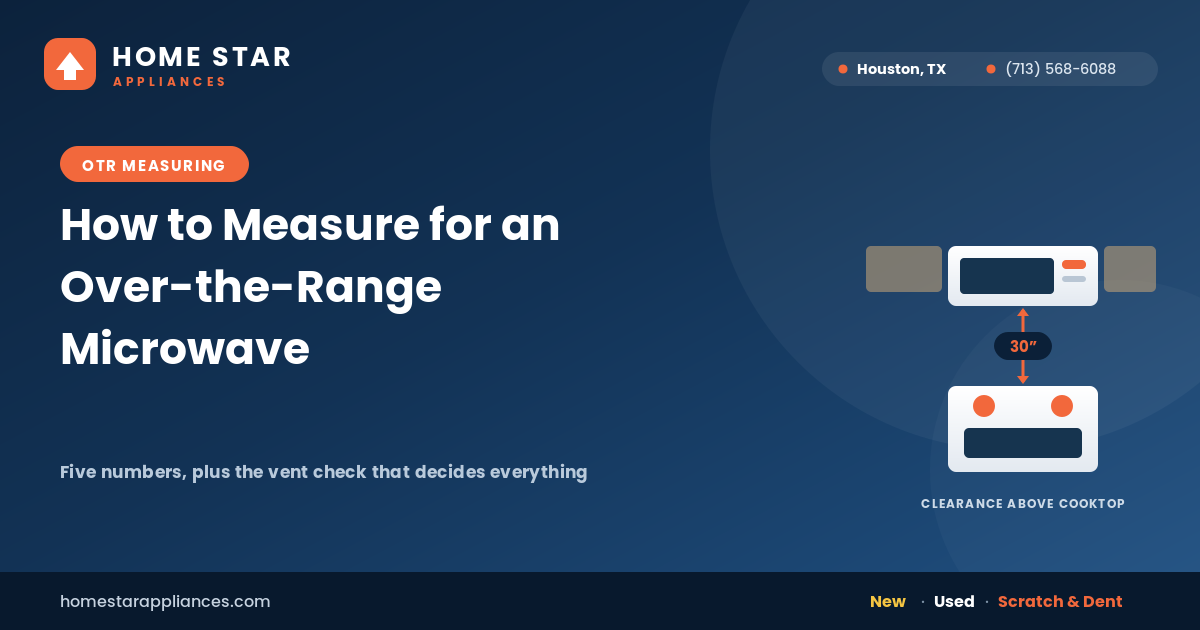
Nearly every manufacturer requires 30 inches of vertical clearance between the cooktop surface and the bottom of the microwave. Some units allow 24 inches minimum if their documentation says so explicitly, but 30 is the standard and it’s what most cabinets are built for.
There is also a 66-inch minimum from the floor to the bottom of the microwave, which is about reach and safety.
Why it matters: the microwave sits directly in the column of heat, steam, and grease coming off your burners. Too close and you cook the microwave. That’s not a metaphor, the underside plastic warps, the grease filters clog fast, the electronics run hot, and it’s a genuine fire consideration with a gas cooktop.
How to measure it: put the tape on the cooktop surface (the burner grates or the glass, not the counter) and measure straight up to the bottom edge of the upper cabinet. You need at least 30 inches of that gap for a standard install, and the microwave’s bottom will sit roughly flush with the bottom of that cabinet.
If you have less than 30 inches: your options are to raise the cabinet, choose a low-profile OTR (a newer category, roughly 10 inches tall instead of 17, designed for tight clearances), or go with a countertop microwave and a proper range hood. That comparison is in over-the-range vs. countertop microwaves.
3. Opening height
A standard OTR is about 16 to 17 inches tall. Low-profile models run about 10 to 11 inches.
Measure from the bottom edge of the upper cabinet down to the cooktop. Subtract 30 inches of required clearance. What’s left has to accommodate the microwave’s height, and in most kitchens the microwave’s bottom simply aligns with the bottom of the cabinet run.
Also check what’s inside that upper cabinet. In a ducted install, the vent goes up through the floor of that cabinet, and you lose the bottom of it. If it’s a shallow cabinet you use for spices, you’re about to lose it.
4. Depth and protrusion
OTR microwaves are typically 15 to 18 inches deep, which is deeper than the standard 12-inch upper cabinet. That means it will stick out past your cabinets, and it’s supposed to. That overhang is what puts the fan and filters over the front burners where the steam actually is.
What to check:
- The microwave door, when open, must clear the front of the cabinets and anything nearby.
- Nothing should sit so far forward that you knock your head on it while cooking at the front burners. This is a real complaint with deeper models in narrow kitchens.
- Measure from the back wall to the front edge of the upper cabinet, so you know how much of the microwave will protrude.
5. The vent path: decide this before you buy
Every OTR is convertible, meaning the same unit can be configured three ways. Which one applies to you determines whether this microwave is a ventilation appliance or just a fan.
| Vent type | Where the air goes | What you need |
|---|---|---|
| Vertical (up) | Up through the cabinet and out the roof | A duct in the cabinet above. Best performance |
| Horizontal (rear) | Out through the exterior wall behind | An exterior wall and a wall cap |
| Recirculating | Through a charcoal filter, back into your kitchen | Nothing. And it removes almost no steam or heat |
Find out which one your kitchen has before you order. Pull the existing microwave (two people, it’s heavy) or look in the cabinet above for a duct opening. If there’s a metal duct going up, you’re vented. If there’s nothing but cabinet floor, you’re recirculating.
This matters most on a gas cooktop, where venting outside actually affects your indoor air. See gas vs. electric stove.
Also note the blower orientation: on most models you physically rotate the fan assembly to switch between vertical, horizontal, and recirculating. It’s part of installation, not a purchase decision, but if you’re hiring someone, tell them which configuration you need.
Electrical and mounting
- Power: an OTR needs a standard 120V grounded outlet, and it should ideally be on its own circuit. That outlet almost always lives inside the cabinet above. If there isn’t one, that’s an electrician’s job before install day.
- Mounting: the unit hangs on a metal wall plate anchored into wall studs, and bolts up through the floor of the cabinet above. Confirm there are studs where the plate needs to land.
- Weight: 50 to 90 pounds. This is a genuinely two-person installation, and holding it in place while someone drives bolts overhead is the hardest part.
- Cabinet strength: the cabinet above carries part of the load. If it’s flimsy or poorly anchored, fix that first.
Replacing an existing OTR
The easiest case, but don’t assume it’s a drop-in:
- Photograph everything before you take the old one down, especially the duct and the outlet position.
- Note the vent configuration of the old unit so the new one gets set the same way.
- Check the height of the new unit. If the old one was a standard 17-inch model and the new one is the same, you’re fine. Swapping a standard for a low-profile leaves a gap above.
- The wall plate is usually not reusable. New unit, new plate, new holes. Expect to patch.
The checklist
- Cabinet opening width (need 30 in.).
- Cooktop surface to bottom of upper cabinet (need 30 in.).
- Floor to bottom of microwave (need 66 in. minimum).
- Cabinet depth and how far the unit will protrude.
- Vent path: up, back, or recirculating.
- 120V outlet in the cabinet above.
- Studs behind the mounting plate.
Bring those numbers and a photo of the cabinet when you shop. If anything is tight, especially that 30-inch clearance, tell us before you buy. And if you’re replacing the range at the same time, measure both together: how to measure for a new range or stove.
Frequently asked questions
How much space do you need above a stove for a microwave?
Most manufacturers require 30 inches from the cooktop surface to the bottom of the microwave, and at least 66 inches from the floor. Some models permit less if their documentation explicitly allows it, but 30 inches is the standard and it’s a safety clearance, not a preference.
What size cabinet opening does an over-the-range microwave need?
Thirty inches, matching a standard range below. The microwave itself is usually about 29 ¾ inches wide. Measure at the front and back of the opening, since cabinets are rarely perfectly square and trim can steal half an inch.
Do over-the-range microwaves stick out past the cabinets?
Yes, and they’re designed to. They’re typically 15 to 18 inches deep versus a 12-inch upper cabinet, which puts the fan and filters out over the front burners where the steam actually rises. Just make sure the open door clears everything nearby.
How do I know if my microwave vents outside?
Look inside the cabinet above the microwave. If there’s a metal duct running up, it’s vented vertically. If the unit exhausts through the wall behind it, it’s vented horizontally. If there’s no duct at all, it’s recirculating, filtering air and blowing it back into the kitchen.
Can I install an over-the-range microwave myself?
It’s a two-person job. The unit weighs 50 to 90 pounds and hangs from a wall plate anchored into studs, with bolts driven up through the cabinet floor while someone holds the weight. It also needs a 120V outlet in the cabinet above and the blower set to the right vent orientation.
What if I don’t have 30 inches of clearance?
You can raise the upper cabinet, choose a low-profile OTR (roughly 10 inches tall instead of 17, made for exactly this problem), or skip the OTR entirely and pair a range hood with a countertop microwave. Don’t just install it closer, that clearance is a fire-safety spec.
Come see the difference for yourself
Home Star Appliances has served Houston since 2018 with new, scratch-and-dent, and quality-tested used refrigerators, washers, dryers, stoves, dishwashers, and microwaves, plus delivery, installation, parts, and financing. Come look at the units in person and ask us anything.
Visit us: 10216 Almeda Genoa Rd, Houston, TX 77075
Call: (713) 568-6088
Hours: Monday–Saturday, 9:00 AM – 7:00 PM (Sunday by appointment)
Browse our current inventory or contact our team.
Related reading
- Over-the-Range vs. Countertop Microwaves: Which to Buy
- How to Measure for a Microwave Before You Buy
- How to Measure for a New Range or Stove
- Gas vs. Electric Stove: Which Is Right for Your Kitchen?
- Best Cooking Appliances for a Kitchen Remodel
- 10 Foods You Should Never Put in a Microwave
- Slide-In vs. Freestanding Ranges Explained
Shop Appliances in Houston, TX
Ready to buy? Home Star Appliances carries new, used, and scratch-and-dent appliances in Houston with delivery, installation, and financing across Houston and the surrounding areas.