
These two ranges cook identically. Same burners, same oven, often the same internals from the same factory. The difference is entirely about how the range meets your cabinets, and it decides how the kitchen looks, what you pay, and how easy your next replacement will be.
Get this wrong and you discover it on delivery day, when the new range doesn’t sit right and there’s a two-inch gap where the old backguard used to be.
The actual difference
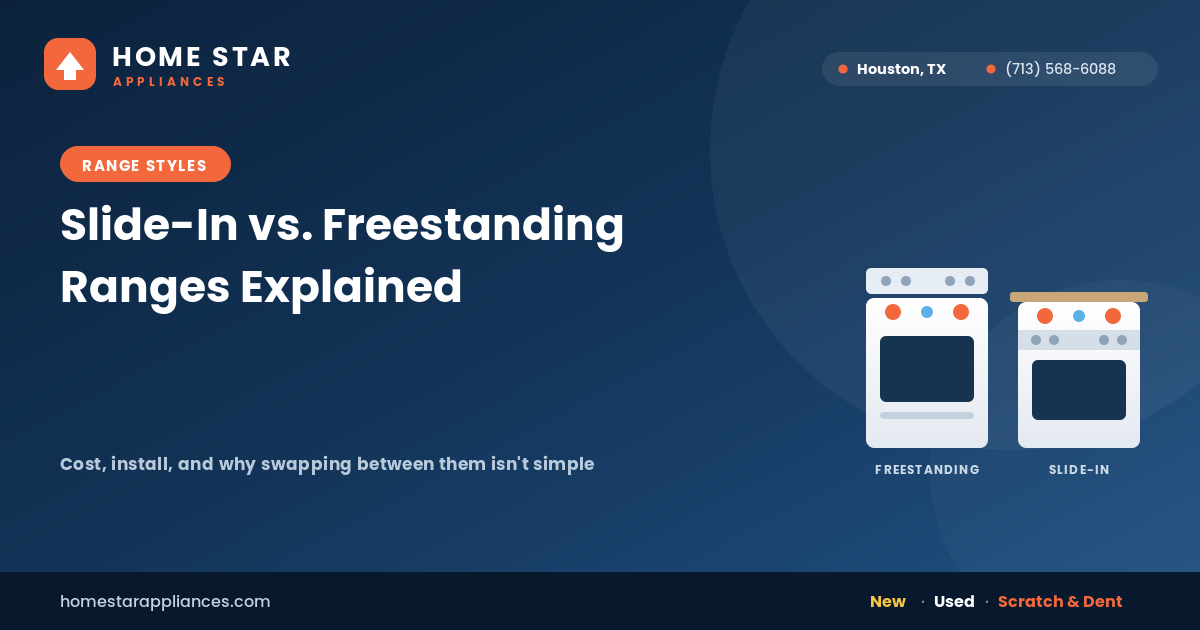
A freestanding range has finished side panels and a tall control panel (a "backguard") standing up at the back. It can go anywhere, including at the end of a cabinet run or standing alone in a room, because no side of it needs hiding. Its cooktop sits fully within its own width.
A slide-in range has unfinished sides and no backguard. The controls are on the front. The cooktop is slightly wider than the body and its edges overlap the countertop on both sides, which is what creates the built-in look and seals off the gap where crumbs and spills normally fall.
That overlap is the whole point of a slide-in, and it’s also the reason you can’t just swap one in.
Head to head
| Freestanding | Slide-In | |
|---|---|---|
| Typical price | $550–$1,400 | $1,000–$2,200 |
| Controls | Rear backguard, above the cooktop | Front, below the cooktop |
| Side panels | Finished. Can be exposed | Unfinished. Must be hidden by cabinets |
| Placement | Anywhere, including the end of a run | Cabinets required on both sides |
| Countertop | Sits between counters, no overlap | Cooktop edges rest on the counter |
| The crumb gap | Yes, on both sides | Sealed. This is the main selling point |
| Backsplash | Covered by the backguard | Exposed. You’ll see the wall behind it |
| Selection | Widest by far, every brand and price | Narrower, mostly mid to premium |
| Replacing it later | Simple. Slide out, slide in | Constrained. Must be another slide-in |
| Safety with kids | Controls out of reach at the back | Front knobs are reachable by toddlers |
The case for freestanding
It costs less and there’s far more to choose from. At every price point, from a $600 basic gas range to a $1,400 convection model, the freestanding market is deeper. If your budget is a real constraint, this is where the value lives.
It’s also the most forgiving choice. It doesn’t care what your countertop looks like, whether your cabinets are square, or whether the range sits at the end of a run. The backguard covers the wall behind it, which means you don’t need finished backsplash tile back there. And when it dies in twelve years, any freestanding range in the store will drop straight into the hole.
One underrated benefit: the controls are at the back, out of a toddler’s reach. If you have small kids, that’s worth more than the aesthetic.
The cost is the gap. There will be a narrow slot between the range and the counter on each side, and food will find it.
The case for slide-in
It looks like it belongs there. The cooktop lip covers the gap on both sides, so the counter reads as one continuous surface interrupted by a cooktop, rather than an appliance shoved between two cabinets. In an open-plan kitchen where the range is visible from the living area, that difference is real.
Front controls are also easier to reach without leaning over hot pots, and with no backguard, your backsplash tile is fully visible, which is the whole reason people tile behind a range in the first place.
The costs: you pay $300 to $700 more for the same cooking performance, your selection is narrower, you’re committed to slide-ins forever (a freestanding replacement will leave the old counter cutout exposed), and those front knobs are exactly at toddler height.
The installation catch nobody mentions
This is where people get hurt, so read it carefully.
- Freestanding → slide-in: usually possible, but not always clean. The slide-in cooktop needs to rest on the countertop, so your counters must be the right depth and the cutout width has to be right. Some installs need the countertop trimmed. Budget for that.
- Slide-in → freestanding: this is the ugly one. If the previous owner had a slide-in with the counter cut around it, dropping in a freestanding range can leave a visible notch or gap in the counter, and the freestanding backguard may not cover it.
- Gas or electric doesn’t change any of this. Both styles come in both fuels. The hookup question is separate, and covered in gas vs. electric stove.
The practical rule: replace like with like unless you’re also touching the countertops. If the counters are already coming out for a remodel, that’s the moment to switch styles. Otherwise, buy the same style you have and put the money you saved into a better oven.
What about "drop-in" and "front-control freestanding"?
Two more terms you’ll see on a showroom floor:
Drop-in ranges sit inside a cabinet cutout with no storage drawer beneath, supported by the cabinetry itself. They’re rare, they’re a custom-kitchen thing, and they’re the hardest of all to replace. Avoid unless your kitchen already has one.
Front-control freestanding ranges are the clever middle path, and worth knowing about. They have a freestanding body (finished sides, no counter overlap, drops into any standard opening) but with the controls moved to the front, giving you most of the slide-in look for closer to freestanding money. If you like the slide-in aesthetic but don’t want the installation commitment, this is the answer.
Which should you buy?
| Your situation | Buy |
|---|---|
| Replacing a freestanding range, no remodel | Freestanding |
| Tightest budget | Freestanding |
| Range sits at the end of a cabinet run | Freestanding (a slide-in’s bare side would show) |
| Small children in the house | Freestanding (rear controls) |
| Rental property | Freestanding (cheapest, easiest to replace) |
| Replacing an existing slide-in | Slide-in |
| Remodeling and replacing countertops anyway | Either. This is your one chance to switch |
| Open-plan kitchen, appearance matters | Slide-in, or front-control freestanding |
| Want the look without the commitment | Front-control freestanding |
Whichever way you go, measure the opening before you buy anything, width, height, and depth including the handle. Our guide to measuring for a new range or stove walks through it.
Worth knowing: a scratch-and-dent slide-in is an unusually good buy, because the cosmetic damage is almost always on a side panel, and a slide-in’s sides are hidden between cabinets the moment it’s installed. You’re paying a discount for a flaw nobody will ever see. See what "scratch and dent" really means.
Frequently asked questions
What is the difference between a slide-in and freestanding range?
A freestanding range has finished sides and a tall rear control panel, and it can go anywhere, including at the end of a cabinet run. A slide-in has unfinished sides, front controls, and a cooktop that overlaps the countertop on both sides for a built-in look. They cook identically.
Is a slide-in range worth the extra cost?
It typically costs $300 to $700 more for the same cooking performance. You’re paying for appearance: the sealed crumb gap, the visible backsplash, and the built-in look. If the range is visible in an open-plan kitchen, many people think that’s worth it. If it’s tucked in a galley kitchen, it’s hard to justify.
Can I replace a freestanding range with a slide-in?
Usually yes, but check the countertop first. A slide-in’s cooktop must rest on the counter on both sides, so the cutout width and counter depth have to be right. Some installations require the countertop to be trimmed, so get that assessed before you buy.
Can I put a freestanding range where a slide-in was?
It’s the harder direction. If the counter was cut around the slide-in, a freestanding range can leave a visible notch or gap that its backguard won’t cover. Replace like with like unless you’re redoing the countertops anyway.
Are slide-in ranges safer for kids?
The opposite, generally. Slide-in controls sit on the front at roughly toddler height, while a freestanding range’s controls are on a rear backguard, out of reach. If you have small children, that’s a genuine point in the freestanding column.
What is a front-control freestanding range?
A range with a freestanding body, finished sides, no countertop overlap, so it drops into any standard opening, but with the controls moved to the front for a slide-in look. It gives you most of the aesthetic without the installation commitment or the price.
Do slide-in and freestanding ranges cook differently?
No. The burners, oven cavity, and heating elements are typically the same. The distinction is purely about how the range integrates with your cabinets and counters, not about cooking performance.
Come see the difference for yourself
Home Star Appliances has served Houston since 2018 with new, scratch-and-dent, and quality-tested used refrigerators, washers, dryers, stoves, dishwashers, and microwaves, plus delivery, installation, parts, and financing. Come look at the units in person and ask us anything.
Visit us: 10216 Almeda Genoa Rd, Houston, TX 77075
Call: (713) 568-6088
Hours: Monday–Saturday, 9:00 AM – 7:00 PM (Sunday by appointment)
Browse our current inventory or contact our team.
Related reading
- How to Choose a Range That Fits Your Cooking Style
- Gas vs. Electric Stove: Which Is Right for Your Kitchen?
- How to Measure for a New Range or Stove
- Best Budget Stoves and Ranges for Houston Homes
- 7 Signs It’s Time to Replace Your Stove
- What “Scratch and Dent” Really Means (and Why It Saves You Money)
- Stainless Steel vs. Fingerprint-Resistant Finishes: Which Lasts?
- Best Cooking Appliances for a Kitchen Remodel
Shop Appliances in Houston, TX
Ready to buy? Home Star Appliances carries new, used, and scratch-and-dent appliances in Houston with delivery, installation, and financing across Houston and the surrounding areas.