
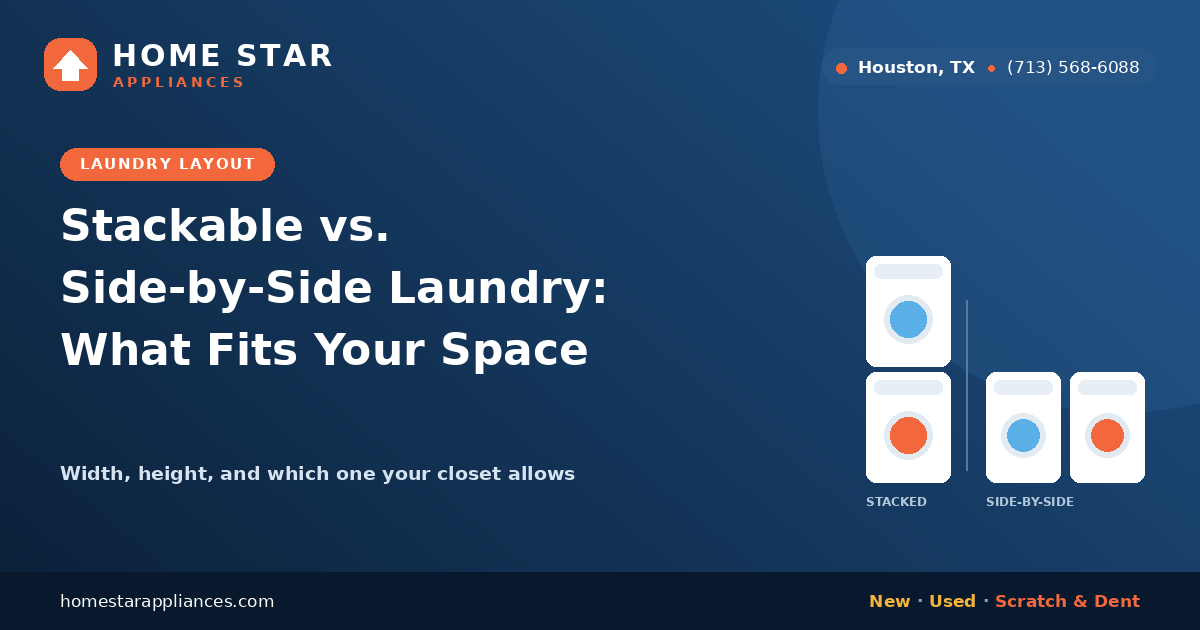
This decision is usually made for you by a tape measure, not a preference. Side-by-side is the better setup in almost every way that matters, and it needs roughly twice the wall. If you have that wall, the article is short. If you don’t, there are four ways to fit laundry into a small space, and only one of them is a compromise you’ll actually enjoy.
The dimensions, up front
| Configuration | Width needed | Height needed | Depth (incl. hoses) |
|---|---|---|---|
| Side-by-side | 54–60″ | 36–40″ | 32–36″ |
| Stacked | 27–30″ | 75–80″ | 32–36″ |
| Laundry center (one unit) | 24–27″ | 70–76″ | 28–32″ |
| All-in-one combo | 24–27″ | 33–39″ | 28–32″ |
Two numbers people forget, and they’re the ones that ruin deliveries:
- Add about 6 inches of depth for hoses, the vent connection, and the machine sitting off the wall. That’s why the closet door won’t close.
- Add about 1 inch on each side for vibration clearance. A washer touching drywall on spin is a washer the whole house can hear.
Measure properly before you shop: how to measure your laundry space.
Side-by-side: the default, and the better setup
Why it wins:
- You can buy any washer. Top-load or front-load, your choice, which matters because top-loaders can’t be stacked and many people prefer them. See top load vs. front load.
- Everything is at a comfortable height. No reaching over your head to a dryer control panel.
- Cheaper. No stacking kit, and you’re not restricted to the front-load models that support stacking.
- Easier to service. A technician can get to both machines. Unstacking a dryer to reach a washer is a real, billable hassle.
- You get a folding surface if you put a counter over the top, which is the single best upgrade to any laundry room.
The only downside: it eats 54–60 inches of wall. That’s the whole argument.
Stacked: the answer for a closet
What you need to know before you commit:
- Only front-load washers can be stacked. A top-loader’s lid opens upward, so there’s nowhere for the dryer to go. If you were set on a top-loader, stacking closes that door.
- You need the manufacturer’s stacking kit, and it’s model-specific. Don’t improvise this. An unsecured dryer on a spinning washer is a genuine safety issue.
- Match the machines. Same brand, same width, and preferably the same series. Mismatched pairs often can’t be stacked at all.
- Check the height with the dryer’s control panel. Some panels stand up at the back and add several inches. If you have a shelf above, this catches people.
- Reach matters. The dryer’s controls end up 60+ inches off the floor. Worth thinking about for shorter members of the household.
- Front-loaders need door clearance, 20–25 inches in front to open fully. In a narrow closet, check the door doesn’t hit the opposite wall.
And the front-loader caveat that matters most in Houston: a stacked front-load washer in a closed laundry closet, in a humid climate, is the perfect environment for a moldy door gasket. Leave the door ajar between loads, every load, and the problem never appears. Close it every time and it will.
The two other options, honestly
Laundry center (a single welded unit)
Washer and dryer in one cabinet, typically 24–27 inches wide. Genuinely compact, and it fits where nothing else will.
The catch, and it’s a serious one: capacity is small, often 2.3–3.5 cu. ft. on the wash side, and if one half fails, you often replace the entire unit. That’s a bad risk profile on an appliance. Buy this when the space leaves you no alternative, not as a preference.
All-in-one washer-dryer combo
One machine that washes and then dries the same load. No vent required, which is its real selling point for interior apartments and condos with no exterior wall.
The trade: drying is slow, often two to three hours for a load, and capacity is limited. You cannot wash a second load while the first dries, which is the whole efficiency of having two machines. For one or two people with no vent option, it’s a reasonable answer. For a family, it’s a bottleneck.
How to decide in 60 seconds
- Measure your width. 54 inches or more? Buy side-by-side and stop reading.
- Under 54 inches but at least 27 wide and 75+ tall? Stack a front-load pair.
- Too short to stack? A laundry center, or a side-by-side compact pair if you can find 48 inches.
- No vent at all? A ventless dryer, or an all-in-one combo.
Also check what’s on the wall before you shop, gas line or not, 240V outlet type, water and drain. Gas vs. electric dryers covers the hookup question.
The money angle
Laundry appliances live in closets, garages, and utility rooms, which is to say nowhere anybody looks. That makes them the single best category for scratch-and-dent: a brand-new machine, full 12–15 year lifespan, discounted 20–60% for a cosmetic flaw in a room with no audience.
Stacked setups have one useful bonus here: the dryer’s sides and the washer’s top are completely hidden once assembled, so a blemish on either is invisible by construction. See where the damage usually is and budget washer and dryer sets.
Frequently asked questions
How much space do you need for a stacked washer and dryer?
Roughly 27–30 inches of width and 75–80 inches of height, plus about 6 inches of depth beyond the machine for hoses and venting. Check the dryer’s control panel height if you have a shelf above.
Can you stack any washer and dryer?
No. Only front-load washers can be stacked, and you need the manufacturer’s model-specific stacking kit. Matching brand and width is essential.
Is stacked or side-by-side better?
Side-by-side, if you have the wall. It lets you buy any washer, keeps everything at a comfortable height, is cheaper and easier to service, and gives you a folding surface. Stack only when width forces it.
Can you stack a top-load washer?
No, because its lid opens upward. If you need a stacked setup, you’re buying a front-load washer.
What if my laundry closet is too short to stack?
A laundry center (a single welded washer-dryer unit) or a compact side-by-side pair. Just know that if one half of a laundry center fails, you often replace the whole thing.
Do stacked washers vibrate more?
They can feel like it, since the dryer sits on top of a spinning drum. A proper stacking kit, a level floor, and an inch of clearance from the walls solves most of it.
Come see the difference for yourself
Home Star Appliances has served Houston since 2018 with new, scratch-and-dent, and quality-tested used refrigerators, washers, dryers, stoves, dishwashers, and microwaves, plus delivery, installation, parts, and financing. Come look at the units in person and ask us anything.
Visit us: 10216 Almeda Genoa Rd, Houston, TX 77075
Call: (713) 568-6088
Hours: Monday–Saturday, 9:00 AM – 7:00 PM (Sunday by appointment)
Browse our current inventory or contact our team.
Related reading
- How to Choose a Washer and Dryer That Fits Your Home
- How to Measure Your Laundry Space Before Buying
- Top Load vs. Front Load Washers: Pros, Cons & Cost
- Gas vs. Electric Dryers: Which Is Better for Houston Homes
- Washer & Dryer Capacity Guide: What Size Do You Need?
- Building the Perfect Laundry Room on a Budget
Shop Appliances in Houston, TX
Ready to buy? Home Star Appliances carries new, used, and scratch-and-dent appliances in Houston with delivery, installation, and financing across Houston and the surrounding areas.