
This is the refrigerator decision people research least and regret most. It isn’t about brand or features, it’s about a few inches of depth, and those inches change how your kitchen looks, how much food you can store, and how much you pay.
Here’s the whole thing, plainly.
The difference in one paragraph
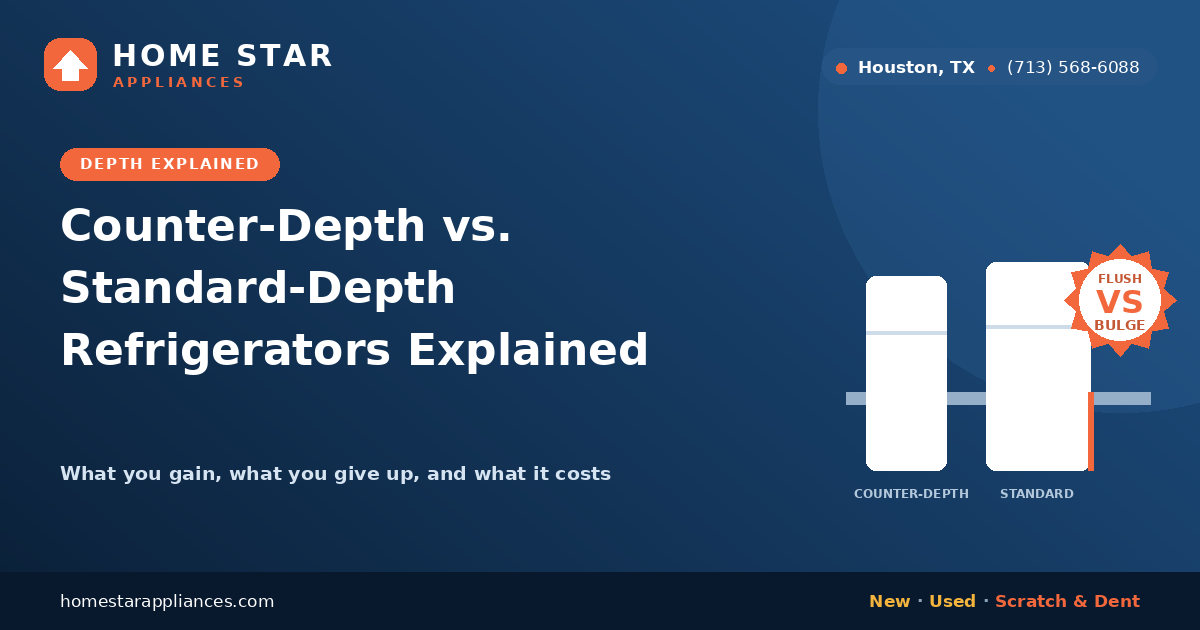
A standard-depth refrigerator is roughly 30–36 inches deep and sticks out several inches past your countertops. A counter-depth refrigerator is roughly 24–30 inches deep and sits nearly flush with the cabinet fronts, so it looks built-in.
That’s it. Same appliance, same technology. One protrudes and one doesn’t, and everything else, the price, the capacity, the feel of the kitchen, follows from that.
Side by side
| Counter-Depth | Standard-Depth | |
|---|---|---|
| Depth | 24–30″ (flush with cabinets) | 30–36″ (protrudes 4–6″) |
| Typical capacity | 18–23 cu. ft. | 20–28 cu. ft. |
| Capacity given up | 3–5 cu. ft. less | — |
| Typical price (new) | $2,000–$3,500 | $1,200–$2,400 |
| Look | Built-in, seamless | Clearly an appliance |
| Walkway impact | None | Eats 4–6″ of floor space |
| Shelf depth | Shallower, easier to reach | Deeper, things get lost at the back |
| Best for | Open kitchens, tight walkways, resale appeal | Storage, families, budget, garages |
The case for counter-depth
- It looks like a custom kitchen. This is the honest main reason people buy it, and it’s a legitimate one. A refrigerator that doesn’t jut into the room changes how the whole kitchen reads.
- It gives you back walkway space. In a galley kitchen or a tight island layout, four to six inches is not cosmetic, it’s the difference between squeezing past someone and not.
- Nothing gets lost at the back. Shallower shelves mean you can actually reach what’s in there. The archaeological dig for a forgotten container of leftovers is a standard-depth problem.
- Resale. In a higher-end home, a protruding refrigerator reads as a compromise. That may or may not matter to you.
The case for standard-depth
- You get 3–5 more cubic feet for less money. That’s a whole extra shelf and then some, and it’s the difference between a weekly shop that fits and one that doesn’t.
- It’s dramatically cheaper. The price gap between an equivalent counter-depth and standard-depth model is often $600–$1,000. You’re paying that to lose storage. Read that again, because it’s the crux of the decision.
- Far more selection. Counter-depth is a premium sub-category, so the discount and used market for it is thinner.
- Nobody notices in an alcove. If your refrigerator sits in a recess with cabinets on both sides and a cabinet above, the protrusion is barely visible anyway, which makes counter-depth’s main benefit largely theoretical.
The honest verdict
Counter-depth is an aesthetic and spatial purchase, not a functional one. You are paying more money for less refrigerator, and that’s a completely rational thing to do if the look matters to you or the walkway is genuinely tight.
What isn’t rational is buying counter-depth by default because it sounds like the better product. It isn’t the better product. It’s the better-looking one.
Buy counter-depth if: your refrigerator is visible in an open-plan space, or it protrudes into a walkway you use constantly, or you’re renovating and the built-in look is the point.
Buy standard-depth if: the fridge sits in an alcove, you have a family to feed, the budget matters, or you’d rather have the extra 4 cubic feet than the flush profile. Which, for most Houston kitchens, is most people.
The trick that gets you both
You can have the built-in look and the storage, and it costs less than you’d think.
- Buy a standard-depth unit and recess it. If you’re doing any cabinetry work, having the alcove built 4–6 inches deeper than standard lets a normal refrigerator sit flush. This is far cheaper than the counter-depth premium and you keep the cubic feet.
- Buy the counter-depth model scratch-and-dent. The premium on counter-depth is what makes it painful. A brand-new counter-depth unit with a dent on a side panel, which will be pressed against a cabinet regardless, routinely lands at standard-depth pricing. Same machine, same 12–15 year lifespan. This is the single best use of the scratch-and-dent discount we see. Read where the dents actually are.
Before you decide, measure
Depth is the dimension people get wrong, because there are three of them: the cabinet depth, the depth with the doors closed, and the depth with the handles, which can add 2–3 inches and quietly undo the flush look you paid for. Also confirm the door can open past 90 degrees, or you won’t be able to pull the crisper drawers out. Full walkthrough: how to measure your space for a new refrigerator.
Frequently asked questions
What is the difference between counter-depth and standard-depth?
Counter-depth refrigerators are 24–30 inches deep and sit nearly flush with your cabinets. Standard-depth models are 30–36 inches deep and protrude 4–6 inches past the counters. Counter-depth looks built-in; standard-depth holds more.
How much capacity do you lose with counter-depth?
Typically 3–5 cubic feet compared with an equivalent standard-depth model, which is roughly a full shelf of storage.
Is counter-depth worth the extra money?
Only if the look or the walkway space matters to you. You’re paying $600–$1,000 more for less storage, which is a fair trade for an open-plan kitchen and a poor one for a refrigerator hidden in an alcove.
Can a standard-depth refrigerator look built-in?
Yes, if you recess the opening 4–6 inches deeper than standard. It’s usually cheaper than the counter-depth premium and you keep the extra cubic feet.
Do handles count toward the depth?
Yes, and people forget. Handles add 2–3 inches beyond the door face, so a "counter-depth" unit can still protrude slightly. Check the spec sheet for depth with handles.
Come see the difference for yourself
Home Star Appliances has served Houston since 2018 with new, scratch-and-dent, and quality-tested used refrigerators, washers, dryers, stoves, dishwashers, and microwaves, plus delivery, installation, parts, and financing. Come look at the units in person and ask us anything.
Visit us: 10216 Almeda Genoa Rd, Houston, TX 77075
Call: (713) 568-6088
Hours: Monday–Saturday, 9:00 AM – 7:00 PM (Sunday by appointment)
Browse our current inventory or contact our team.
Related reading
- How to Measure Your Space for a New Refrigerator
- How to Choose the Right Refrigerator for Your Kitchen
- Best Refrigerator Sizes for Small Kitchens
- French Door vs. Side-by-Side vs. Top Freezer: Which to Buy
- Scratch-and-Dent Refrigerators: Where the Dents Actually Are
Shop Appliances in Houston, TX
Ready to buy? Home Star Appliances carries new, used, and scratch-and-dent appliances in Houston with delivery, installation, and financing across Houston and the surrounding areas.