
Every appliance has an expected lifespan, and knowing it is the difference between "why is this thing breaking?" and "ah, right, it’s fourteen."
It also tells you whether a repair quote is a good idea or throwing money into a dying machine.
Here are the honest numbers.
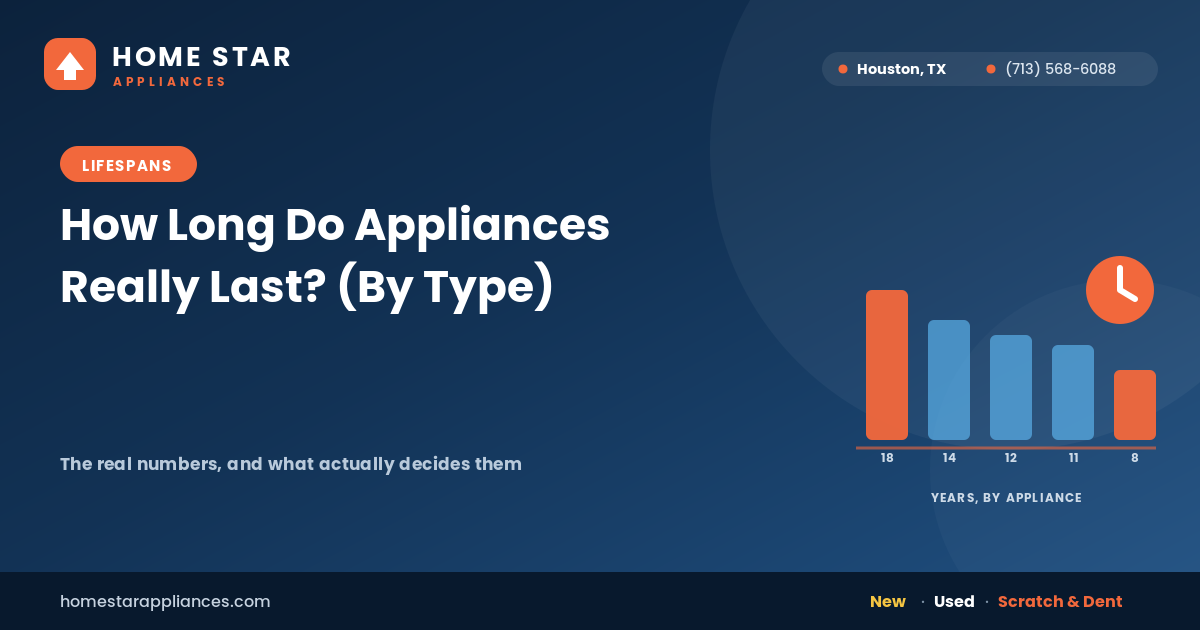
Lifespan by appliance
| Appliance | Typical lifespan | What usually ends it |
|---|---|---|
| Freezer (chest) | 15–20 years | Almost nothing. It’s a compressor in a box |
| Range / stove (gas) | 15–18 years | Control board, or the owner gives up on it |
| Range / stove (electric) | 13–15 years | Elements, control board, cracked cooktop |
| Refrigerator | 12–15 years | Compressor, sealed system, control board |
| Washer | 10–13 years | Bearings, transmission, control board |
| Dryer | 10–13 years | Motor or drum bearings (everything else is cheap) |
| Dishwasher | 9–12 years | Pump, motor, or the tub itself |
| Microwave (OTR) | 7–10 years | Magnetron or control board. Heat from the cooktop below |
| Microwave (countertop) | 8–10 years | Magnetron. Just replace it |
| Garbage disposal | 8–12 years | Motor, corrosion |
Three things jump out of that table.
The simplest machines last longest. A chest freezer is a compressor, a coil, and a box of insulation. There’s almost nothing to fail, and they routinely run 20 years. A gas range is mechanically simple too, which is why it outlives an electric one.
The most complex ones die first. A dishwasher has a pump, a motor, heaters, sensors, and a control board, all sitting in hot water. An over-the-range microwave sits in the rising heat, steam, and grease from the cooktop below it, which is exactly why it’s the shortest-lived appliance in your kitchen.
The dryer is the outlier worth knowing about. It has a similar lifespan to a washer, but its failures are cheap. Fuses, elements, igniters, belts, and rollers are all inexpensive, well-understood repairs, which means a dryer can be kept running long past the point where another appliance would be scrapped. It’s the most repairable appliance you own, and the best used buy in the store.
Why appliances don’t last like they used to
They genuinely don’t, and it isn’t nostalgia. The fridge in your grandparents’ garage from 1985 is still humming, and there are real reasons for that:
- More electronics. A 1985 fridge had a compressor and a thermostat. A modern one has a control board, sensors, an ice maker, a dispenser, and sometimes a screen. Every one of those is a failure point, and the control board is typically the most expensive part in the machine.
- Efficiency standards changed the engineering. Modern appliances use dramatically less water and electricity, which is genuinely good, but it’s achieved with tighter tolerances, more sensors, and more complex control.
- Cost pressure. Thinner steel, more plastic, lighter components, particularly at the entry level.
- Survivorship bias, in fairness. You remember the 1985 fridge that lasted 30 years. You’ve forgotten the ones that didn’t.
The honest takeaway: that old fridge still running in the garage is also probably costing you $120–$200 a year in electricity, so it isn’t the bargain it appears to be.
What actually determines your appliance’s lifespan
The published number is an average. These four things decide where yours lands.
1. Complexity (the big one)
Every feature is a failure point. A plain fridge with no ice maker, no dispenser, and no touchscreen has dramatically fewer things that can break than a feature-loaded French-door model. This is why a basic Whirlpool routinely outlives a premium showpiece.
If longevity is your priority, buy the plainest version of a reliable brand. See best refrigerator brands for longevity and most reliable appliance brands.
2. Maintenance (the free one)
We repair these machines, and most that die young were helped along:
- Refrigerator: clean the condenser coils twice a year. The most neglected job in the house, and dirty coils make the compressor run hot and die early.
- Dryer: clean the lint filter every load and the full duct annually. This prevents fires as well as repairs.
- Dishwasher: clean the filter every month or two. A clogged filter is the #1 cause of "it stopped cleaning."
- Washer: clean the drain pump filter, keep it level, use less detergent, leave the door ajar.
- Range: stop running the high-heat self-clean cycle. It runs the oven near 900°F for hours and is a well-known killer of control boards, thermal fuses, and door hinges. See cooking habits that shorten your stove’s life.
A well-maintained budget appliance will outlive a neglected premium one. That’s not a platitude, it’s what we see every week.
3. Serviceability
Here’s a subtlety most lifespan articles miss: an appliance’s real lifespan is how long it stays worth fixing.
A Whirlpool that fails at year twelve with a $180 repair becomes a fifteen-year appliance. A premium machine that fails at year twelve with a $600 proprietary part and a two-week wait becomes scrap, because now the repair exceeds the sensible threshold. Cheap, available parts genuinely extend a machine’s life, which is the strongest argument for the mainstream American brands. See GE vs. Whirlpool.
4. Environment (very Houston-specific)
- Heat. A fridge or freezer in an un-airconditioned Houston garage works far harder than one in a kitchen. Get a garage-ready model, or expect a shorter life.
- Humidity. Encourages gasket mildew in front-load washers and corrosion generally.
- Hard water. Scale builds up in dishwashers and washing machines. A monthly vinegar or cleaner cycle helps.
- Power events. Surges and outages are hard on control boards. A surge protector on an expensive appliance is cheap insurance.
How to use these numbers
When something breaks, put the age against the table and decide with your eyes open:
| Age vs. expected life | What it means |
|---|---|
| Under half its expected life | Repair it. Plenty of runway left |
| Around two-thirds | Repair if it’s under ~50% of replacement cost |
| Near or past expected life | Repair only if it’s cheap. Be picky |
| Past expected life + a major failure | Replace |
| Any age + repeated failures | Replace. The machine is telling you |
The full framework, including the age-adjusted 50% rule: when appliance repair costs more than replacement.
The buying lesson
If you want appliances that last:
- Buy simple. Skip the ice maker, the touchscreen, the Wi-Fi. Every feature is a thing that fails.
- Buy serviceable brands. Whirlpool, Maytag, GE, cheap parts, universally repairable.
- Buy build quality over features. Which usually means a mid-tier machine, and often a scratch-and-dent one, rather than a new entry-level unit. See the real cost of "cheap" appliances.
- Then maintain it. Coils, filters, ducts. It’s free and it’s worth years.
Frequently asked questions
How long do appliances last on average?
Refrigerators 12 to 15 years, ranges 13 to 18 (gas lasts longer than electric), washers and dryers 10 to 13, dishwashers 9 to 12, and microwaves only 7 to 10, the shortest-lived appliance in most kitchens. Chest freezers are the champions at 15 to 20 years, because there’s almost nothing in them to fail.
Which appliance lasts the longest?
The chest freezer, at 15 to 20 years, followed by gas ranges at 15 to 18. The pattern is consistent: the simplest machines last longest. A chest freezer is essentially a compressor, a coil, and an insulated box, so there’s very little that can go wrong.
Which appliance has the shortest lifespan?
The microwave, at 7 to 10 years, and over-the-range models are worst because they sit directly in the rising heat, steam, and grease from the cooktop below. They’re also generally not worth repairing, since a magnetron or control board repair can approach the cost of a new unit.
Why don’t appliances last as long as they used to?
Mainly because there’s more to break. An old fridge had a compressor and a thermostat; a modern one adds a control board, sensors, an ice maker, a dispenser, and sometimes a screen. Efficiency standards also required tighter engineering, and there’s real cost pressure on materials. Worth noting: that old fridge still running in the garage is probably costing $120 to $200 a year in electricity.
How can I make my appliances last longer?
Clean refrigerator condenser coils twice a year, clean the dryer lint filter every load and the duct annually, clean the dishwasher filter every month or two, keep the washer level and clean its drain pump filter, and stop running the oven’s high-heat self-clean cycle. A well-maintained budget appliance will outlive a neglected premium one.
Do more expensive appliances last longer?
Not reliably, and often the opposite in the mainstream market, because price usually buys features and features are failure points. What genuinely extends life is simplicity, build quality, and serviceability, cheap, available parts mean a machine stays worth repairing rather than becoming scrap at the first expensive fault.
Come see the difference for yourself
Home Star Appliances has served Houston since 2018 with new, scratch-and-dent, and quality-tested used refrigerators, washers, dryers, stoves, dishwashers, and microwaves, plus delivery, installation, parts, and financing. Come look at the units in person and ask us anything.
Visit us: 10216 Almeda Genoa Rd, Houston, TX 77075
Call: (713) 568-6088
Hours: Monday–Saturday, 9:00 AM – 7:00 PM (Sunday by appointment)
Browse our current inventory or contact our team.
Related reading
- When Appliance Repair Costs More Than Replacement
- Most Reliable Appliance Brands (and Why)
- Best Refrigerator Brands for Longevity
- Houston Homeowners: When to Repair vs. Replace an Appliance
- Refrigerator Repair in Houston: Common Problems & Fixes
- Cooking Habits That Can Shorten the Life of Your Stove
- The Real Cost of “Cheap” Appliances vs. Certified Used
- Signs Your Refrigerator Is About to Fail
- Should You Repair or Replace a 10-Year-Old Appliance?
- How to Make Your Refrigerator Last Longer
- Energy-Efficient Appliances: How Much Can You Really Save?
- Appliance Maintenance Checklist Every Homeowner Needs
Shop Appliances in Houston, TX
Ready to buy? Home Star Appliances carries new, used, and scratch-and-dent appliances in Houston with delivery, installation, and financing across Houston and the surrounding areas.