
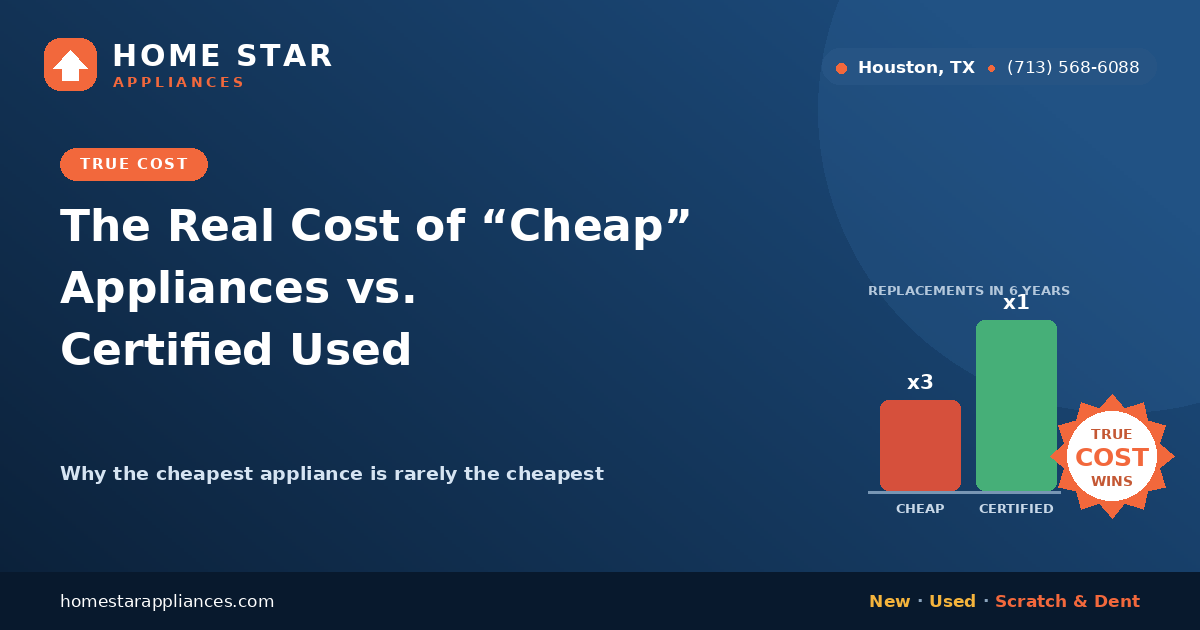
There are two ways to spend as little as possible on an appliance. One of them works.
The first is to buy the cheapest thing available: a bottom-tier new appliance from a big-box clearance aisle, or an untested unit off a marketplace app for $150. The second is to buy a certified used or scratch-and-dent appliance, which costs more upfront and less overall. The gap between those two strategies is not small, and it is not obvious at the register, which is exactly why so many people get it wrong.
Let’s put numbers on it.
What "cheap" actually costs
Take a washer. Three ways to buy one.
| Bargain-bin new | Marketplace used (untested) | Certified used / scratch-and-dent | |
|---|---|---|---|
| Purchase price | $449 | $175 | $380–$600 |
| Tested before sale? | N/A (new) | No | Yes, full cycle under load |
| Return if it fails? | Store policy | No | Yes |
| Repair support | Manufacturer, remote | None | In-house service |
| Realistic service life | 5–7 yrs (built to a price) | 1–5 yrs (unknown) | 6–8 yrs used / 12–15 scratch-and-dent |
| Expected service calls | 1–2 | 2+, or immediate failure | 0–1 |
| Cost per year | ~$75–$110 | ~$60–$200+ | ~$50–$65 |
Look at the marketplace column. Its cost-per-year has a range so wide it’s almost meaningless, and that is the finding. You might get five good years for $175. You might get four months and a flooded laundry room. You’re not buying an appliance, you’re buying a lottery ticket with an appliance-shaped prize.
The three hidden costs of a cheap appliance
1. It was built to a price, not to a standard
This is the one nobody wants to hear about bargain-bin new appliances. A $449 new washer is not a $900 washer with a discount, it’s a different machine: thinner components, a smaller motor, a shorter warranty, and a service life engineered down to hit a price point. It’s new, which feels safe, and it may well die before a properly tested six-year-old mid-tier machine does. New is not a synonym for durable.
2. The service calls
A service call in Houston is not free. Between the trip charge, the diagnostic, the part, and the labor, a single repair can easily run $150–$300. Two of those and the "cheap" appliance has quietly overtaken the certified one you didn’t buy. And the cheaper the appliance, the sooner you hit the point where the repair costs more than the machine is worth, which is where people find themselves buying the same appliance twice. See when to repair vs. replace an appliance.
3. The failure itself
The cost that never appears in anyone’s spreadsheet. A refrigerator that dies is a few hundred dollars of spoiled groceries and a scramble. A washer that leaks is a floor. A dryer that stops working is a laundromat habit. If you’re a landlord, it’s an emergency call and a tenant who now trusts you less, see buying a used appliance for a rental property. These costs are real, they’re just invisible until they arrive.
The replacement cycle is where the money actually goes
Here’s the number that settles the argument. Over 12 years, what does each path really cost you?
- Cheapest option, repeatedly: a $175 untested washer that lasts ~3 years, bought four times, plus a couple of repairs and one bad failure. Call it $700–$1,100, spread across four separate hassles, four deliveries, and four days without laundry.
- Bargain-bin new: a $449 machine that lasts 6 years, bought twice, plus repairs. Call it $1,000–$1,300.
- Certified used: a $380 tested machine that lasts 7 years, then replaced once. Roughly $760–$900, with far fewer surprises.
- Scratch-and-dent: a $600 brand-new machine that lasts the full 12–15 years. $600. Once.
Read that last line again. The most expensive option at the register is the cheapest option over the life of the appliance, by a wide margin, and it’s also the one where you don’t spend four separate weekends dealing with a washer.
What "certified" is actually buying you
The word gets thrown around, so here’s the concrete content of it. When we sell a certified used appliance, it has been:
- Screened at intake (no flood, fire, or water damage, no missing serial plate)
- Run through a complete operating cycle under load, not powered on for ten seconds
- Tested across 12 functional areas, motors, seals, drainage, controls, temperature hold, electrical safety
- Repaired with proper parts where needed, and retested after the repair
- Rejected outright if it has an intermittent fault we can’t reliably eliminate
- Sold with a 30-day return policy and an in-house Houston service team behind it
The full process is here: how we inspect and certify used appliances. What you’re paying the premium for is not the appliance. It’s the elimination of the tail risk, the small chance of a total loss that makes the cheap option’s average cost so much worse than its sticker price.
When cheap is actually the right call
We’re not going to pretend it never is:
- You need something for six months. A stopgap before a renovation, a short lease, a house you’re about to sell. Buy the cheapest thing that works and don’t overthink it.
- You’re genuinely capable of repairing it yourself. If you can replace a drain pump on a Saturday, the risk calculus changes completely, and cheap becomes rational.
- The appliance is low-consequence. A garage backup fridge for drinks. A rarely used second microwave. Nothing bad happens if it dies.
- It’s genuinely all you can spend right now. That’s a legitimate constraint, and we’d rather you have a working appliance than a perfect one. Just go in knowing what you’re taking on.
The rule
Stop asking "what does it cost?" and start asking "what does it cost per year, and what happens if it dies?" Run that calculation and the answer flips almost every time. The cheapest appliance is rarely the cheapest appliance.
Full pricing breakdown by category: how much you can save buying used appliances in Houston.
Frequently asked questions
Are cheap appliances worth buying?
Rarely, unless you need a short-term stopgap, can repair it yourself, or the appliance is genuinely low-consequence. Over a full replacement cycle, cheap appliances usually cost more than certified used or scratch-and-dent because of shorter lifespans, more service calls, and the cost of failure.
What does "certified used" actually mean?
That the appliance was screened at intake, run through a complete cycle under load, tested across 12 functional areas, repaired with proper parts where needed, retested, and sold with a return policy and service support. It’s the elimination of the unknown, which is the thing you’re actually paying for.
Is a cheap new appliance better than a certified used one?
Not necessarily. A bottom-tier new appliance is engineered down to a price and may have a shorter service life than a properly tested mid-tier used unit. "New" and "durable" are not the same word.
How much does an appliance repair cost in Houston?
Commonly $150–$300 once you include the trip charge, diagnosis, parts, and labor. Two repairs will typically erase whatever you saved by buying the cheapest option.
What’s the cheapest appliance over its whole life?
Usually scratch-and-dent: a brand-new machine with a full 12–15 year lifespan bought at a 20–60% discount. It costs the most today and the least per year, which is the only comparison that matters.
Come see the difference for yourself
Home Star Appliances has served Houston since 2018 with new, scratch-and-dent, and quality-tested used refrigerators, washers, dryers, stoves, dishwashers, and microwaves, plus delivery, installation, parts, and financing. Come look at the units in person and ask us anything.
Visit us: 10216 Almeda Genoa Rd, Houston, TX 77075
Call: (713) 568-6088
Hours: Monday–Saturday, 9:00 AM – 7:00 PM (Sunday by appointment)
Browse our current inventory or contact our team.
Related reading
- How Much Can You Save Buying Used Appliances in Houston?
- How We Inspect and Certify Used Appliances Before Selling Them
- Buying a Used Appliance for a Rental Property: Smart or Risky?
- 7 Myths About Used Appliances
- Houston Homeowners: When to Repair vs. Replace an Appliance
- GE vs. Whirlpool Appliances: A Buyer’s Comparison
- Is LG a Good Appliance Brand? Honest Pros & Cons
- Best Budget Appliance Brands Worth Buying
- Most Reliable Appliance Brands (and Why)
- Best Appliance Brands for Scratch-and-Dent Deals
- How to Finance Appliances with Bad or No Credit
- When Appliance Repair Costs More Than Replacement
- How Long Do Appliances Really Last? (By Type)
- Energy-Efficient Appliances: How Much Can You Really Save?
Shop Appliances in Houston, TX
Ready to buy? Home Star Appliances carries new, used, and scratch-and-dent appliances in Houston with delivery, installation, and financing across Houston and the surrounding areas.