
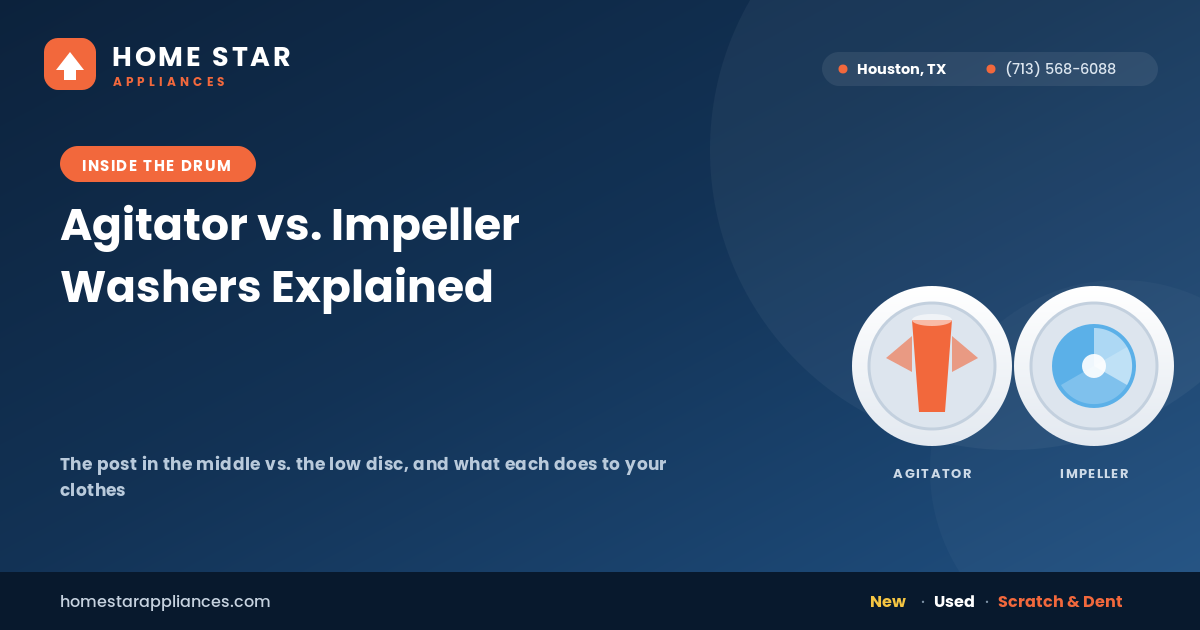
Open two top-load washers side by side and you’ll see the difference immediately. One has a tall post standing in the middle of the drum. The other has a flat, low disc at the bottom and nothing else. That post is an agitator. The disc is an impeller.
They clean clothes in completely different ways, and that difference is behind almost every complaint people have about "high-efficiency washers." If you’ve heard someone say HE machines don’t get clothes clean, or that they leave the load tangled in a rope, they were almost certainly talking about an impeller. Knowing which one you’re buying matters more than the brand on the door.
How each one actually washes
An agitator is a mechanical scrubber. The post twists back and forth, dragging clothes against its fins and against each other. Friction does the work. It’s fast, it’s aggressive, and it needs a full tub of water for clothes to move through.
An impeller doesn’t scrub. The disc spins and wobbles, setting the whole load in a slow circulating motion so garments rub gently against one another in a shallow pool of water. Less water, less friction, longer cycle. It relies on time and detergent chemistry more than force.
That single design choice cascades into everything else.
Head to head
| Agitator | Impeller | |
|---|---|---|
| Typical price | $550–$900 | $700–$1,100 |
| Cleaning on heavy soil | Excellent (mechanical scrubbing) | Good, but needs time |
| Cycle length | 35–50 minutes | 60–90 minutes |
| Water use | High | Low (roughly a third less) |
| Usable capacity | Smaller, the post steals space | Larger, full open drum |
| Gentle on fabric | No. Hardest on clothes of any washer | Yes, much gentler |
| Bulky items (comforters) | Poor. Won’t fit around the post | Good |
| Tangling / roping | Some, around the post | Common, especially with sheets |
| Spin speed / dryness out | Moderate | Higher, shorter dryer time |
| Repair complexity | Simple, cheap parts | Slightly more electronics |
The case for the agitator
It cleans hard-soiled laundry better than any other top-loader, full stop. Work clothes, kids’ sports uniforms, greasy shop rags, Houston yard dirt: the agitator’s mechanical action beats it out. It finishes in about half the time of an impeller. It costs less to buy. And it’s mechanically simple, which means cheaper repairs and a longer usable life.
Its cost is fabric. All that friction wears clothes faster and it’s rough on anything delicate. Stretched-out collars and pilled cotton are the agitator’s signature. It also can’t handle bulk, a king comforter simply won’t circulate around the post, it just wraps it.
Buy an agitator if: your laundry is genuinely dirty, you want the cycle done fast, you want the cheapest reliable machine, or you’re buying for a rental where simplicity wins.
The case for the impeller
You get a bigger usable drum out of the same footprint, because nothing occupies the middle. You get a machine that’s far gentler on fabric. You use less water and less energy. And it spins faster at the end of the cycle, which pulls out more water and shortens your dryer time, a real cost saving that most shoppers overlook.
Its cost is time and technique. Cycles run long. And it’s fussier about how you load it. Impellers reward a certain discipline that agitators forgive.
Buy an impeller if: you wash big or bulky items, you care about your clothes lasting, you want a large-capacity top-loader, or your utility bill matters.
Why impeller loads come out tangled (and how to stop it)
This is the single most common complaint, and it’s almost always a loading problem rather than a machine problem.
- Load loosely and evenly around the drum, not dumped in the middle. The impeller moves clothes in a circle; a pile in the center can’t circulate.
- Don’t overfill. Fill to about three quarters. Clothes need room to move or nothing rubs against anything.
- Wash sheets and long items separately, or at most two at a time. Bedsheets are what rope up.
- Mix garment sizes. A drum of nothing but towels is fine; a drum of towels plus one duvet cover is a knot waiting to happen.
- Use less detergent, not more. HE machines use less water, so old-fashioned dosing leaves suds that never rinse out. This causes most of the "my clothes don’t smell clean" complaints.
Get those right and the impeller stops being annoying. Our guide to 8 laundry mistakes that could be damaging your clothes covers the rest.
Where the front-loader fits in
Worth saying clearly, because shoppers conflate these three: agitator and impeller are both top-loaders. A front-loader is a third design that has neither. It tumbles clothes through a shallow pool using gravity, which is why it cleans as well as an agitator while being as gentle as an impeller.
The trade-off there is different, chiefly the door gasket, which will grow mildew if you don’t leave the door ajar. If you’re weighing all three, read top load vs. front load washers next.
Which one should you buy?
| Your situation | Pick |
|---|---|
| Heavily soiled work or sports laundry | Agitator |
| Want the cycle done in 40 minutes | Agitator |
| Tightest budget, simplest machine | Agitator |
| Rental property, low-maintenance | Agitator |
| Wash comforters, blankets, big bedding | Impeller |
| Want clothes to last longer | Impeller |
| Need max capacity in a top-loader | Impeller |
| Care about water and energy bills | Impeller |
| Want the best cleaning and the gentlest handling | Front-loader, not a top-loader at all |
If you’re still torn, be honest about your laundry rather than your ideals. Most households don’t have heavily soiled clothes; they have moderately dirty clothes and a lot of them. That’s an impeller household. Households with a workshop, a yard, or a youth sports schedule are agitator households.
Whichever way you go, size it properly first, our washer and dryer capacity guide explains what cubic feet you actually need, and measure your laundry space before you shop.
Frequently asked questions
Which cleans better, an agitator or an impeller?
An agitator cleans heavily soiled laundry better because it scrubs mechanically. An impeller cleans normal household laundry just as well, it simply needs a longer cycle to do it. For everyday clothes there’s little practical difference in the result.
Is an impeller washer gentler on clothes?
Yes, noticeably. There’s no post dragging fabric against fins, so there’s far less abrasion. If stretched collars, pilling, and worn-out cotton bother you, the impeller is the kinder machine.
Why do my clothes come out tangled in an impeller washer?
Almost always a loading issue. Spread items loosely around the drum instead of piling them in the middle, keep the load to about three quarters full, and wash sheets and long items in small batches. Overloading is the number one cause.
Do impeller washers hold more?
Yes. With no agitator post taking up the center, the usable drum volume is larger for the same exterior size, which is why impeller machines handle comforters and bulky bedding that simply won’t fit around an agitator.
Are agitator washers being discontinued?
No. Manufacturers have leaned heavily toward impeller and front-load designs for efficiency reasons, but agitator top-loaders are still made and sold, and they remain popular for exactly the reasons above: fast, cheap, simple, and hard on dirt.
Do impeller washers use less water?
Yes, roughly a third less than a comparable agitator machine, because they wash in a shallow pool rather than a full tub. They also spin faster, so clothes leave the washer drier and spend less time in the dryer.
Which lasts longer?
The agitator machine is mechanically simpler and its parts are cheap, which generally makes it easier and cheaper to keep running for years. That’s a real advantage on a budget, and one reason a well-tested used agitator washer is such a solid buy.
Come see the difference for yourself
Home Star Appliances has served Houston since 2018 with new, scratch-and-dent, and quality-tested used refrigerators, washers, dryers, stoves, dishwashers, and microwaves, plus delivery, installation, parts, and financing. Come look at the units in person and ask us anything.
Visit us: 10216 Almeda Genoa Rd, Houston, TX 77075
Call: (713) 568-6088
Hours: Monday–Saturday, 9:00 AM – 7:00 PM (Sunday by appointment)
Browse our current inventory or contact our team.
Related reading
- Top Load vs. Front Load Washers: Pros, Cons & Cost
- Washer & Dryer Capacity Guide: What Size Do You Need?
- How to Choose a Washer and Dryer That Fits Your Home
- 8 Laundry Mistakes That Could Be Damaging Your Clothes
- Are Used Washers and Dryers Reliable? What to Look For
- what $700 buys in a laundry bundle
- How to Measure Your Laundry Space Before Buying
Shop Appliances in Houston, TX
Ready to buy? Home Star Appliances carries new, used, and scratch-and-dent appliances in Houston with delivery, installation, and financing across Houston and the surrounding areas.